
Revolutionizing Huntsman

I met a traveler from an antique land, who said-"Two vast and trunkless legs of stone stand in the desert..." - Percy Bysshe Shelley
The desert is a fascinating place. Constantly shifting, constantly changing. Even the mighty works of the king of kings were reduced to a boundless and bare colossal wreck in the desert. The nature of entropy, of change, of sand in the desert is a constant nature of our life, a constant presence begging to be acknowledged.
Flesh and Blood decks are much like those two vast and trunkless legs of stone that Shelley describes in the famous poem "Ozymandias". Once great monoliths like Bloodsheath Viserai or Belittle Fai are husks relegated to the passage of time. Even if bans play no part in advancement, like the movement of Iyslander from pure arcane into Hamilton's signature "bullander" list, decks are the exact opposite of stagnant beings. They move, they fluctuate, they adapt, they improve.
No deck in the game exemplifies this monolithic process of change and disruption as much as Arakni, Huntsman. A hero who has stood the test of time and yet found itself fully and completely reformed as the years have passed.

When Arakni hit the scene on November 11th, 2022, the playerbase immediately split into two very different build paths.
The release notes for Dynasty made one thing very clear: Contracts, the main card type of Huntsman's card pool, could stack. If you played Plunder the Poor, gave it go again, and played Leave No Witnesses, and banished a red Head Jab off of that Leave No Witnesses, you would create two Silver tokens. One for Plunder the Poor, and one for Leave No Witnesses. This silver could then be fueled into Blacktek Whisperers for more go again, creating more contract stacks and more Silver and so on and so forth.
The saying goes that the early bird gets the worm, so you could argue that the first deck on the scene would make some waves, and yet, the saying is disproved in this instance. To play two contracts, you needed a minimum of three cards: Two contracts and one go again enabler (Which could be a reaction to push over blocks and ensure a Blacktek hit). With these three cards, though, you weren't usually presenting very much damage, and you definitely weren't presenting any meaningful disruption. Control decks blocked you out, aggro decks ran you over, and midrange decks outvalued you.
Immediately, consensus shifted away from this Christmas-land aggro deck and towards a more "back foot" defensive deck. Players stopped holding on to large hands, instead opting to block efficiently and play out high-value low-to-the-ground lines. Block with three cards, swing with a 0 for 4 contract, attack the deck, preserve the life, and drag the game out to an endgame standstill.
This is the stalwart variation of Huntsman, the bastion, the mighty work of Ozymandius.
Fatigue Huntsman is far and above the most recognizable and reliable version of the hero. But even in its overbearing presence, the deck was far from stagnant.
Obviously, as the card pool doubled in Outsiders, Huntsman took advantage of the new tools, bringing in cards like Codex of Frailty, Flick Knives, extra daggers, and new defensive tools with the traps. The deck was still mostly the same, just with a few extra tools that allowed us to drop some of our generic cards like Heart of Fyendal.
The next major moment of disruption came in Part the Mistveil, with Nuu and Nuu's stealth attacks.
Love them or hate them, Persuasive Prognosis, Bonds of Agony, and Just a Nick are insanely powerful cards. With the release of Part the Mistveil, Huntsman's blue base effectively rotated to include these cards, with a couple of other blue stealth cards to act as glue for Just a Nick. Some might argue that Huntsman should have been running blue stealth cards as early as Outsiders, due to the strength of Looking for a Scrap and Infect, but it became a non-negotiable in Part the Mistveil.
In Hunted, an interesting deck arose focusing on the dagger cards and the mark package to create a super fundamental-oriented gameplan for the hero, and while it is arguable that the deck was stronger than the usual Huntsman gameplan, the deck was mostly unplayed because it was so wildly alien from usual Huntsman decks.
And then LSS dropped the bombshell that is Hunter or Hunted. The card radically reframed the deck, generating a ton of Silver and enabling a very powerful fatigue-focused gameplan with red Double Trouble, equipment reacts, and Contract cards fueling the very same playlines that were created and played out back in Dynasty.
Fatigue Huntsman in the modern day is largely unrecognizable compared to Fatigue Huntsman in Dynasty, and yet the deck operates nearly identically. Block effectively, play out low to the ground efficient playlines, hit the deck, disrupt the hand, slow the game down to a crawl, and drag the opponent into a brutal endgame.
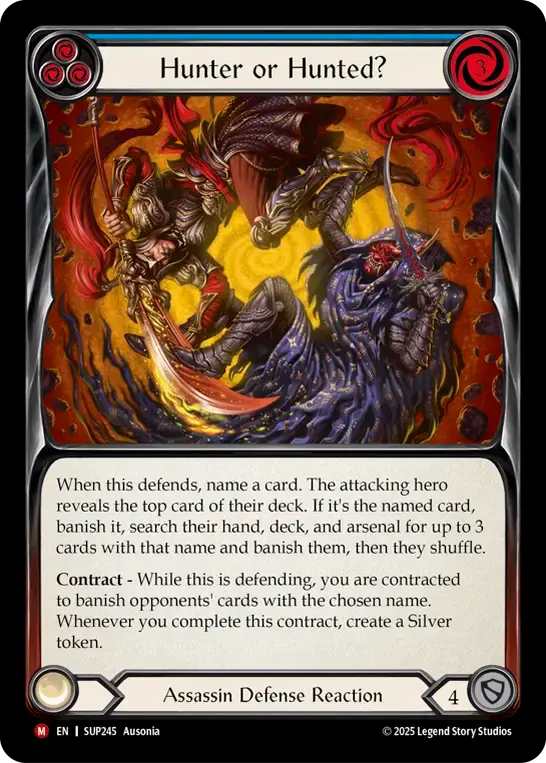
The one connecting thread this entire time is that somehow, against all odds, that aggro variant of Huntsman held on for dear life. I call Fatigue Huntsman a monolith, a stalwart bastion, and yet, players still did everything they could to stack contracts. Coercive Tendencies in Heavy Hitters provided the fuel to drop blue counts into the single digits, Hunted brought in Head Jab adjacent cards to extend chain links well past what should be reasonable. At the end of the day, aggro Arakni was still very much at the table.
Players were constantly looking for ways to push Arakni a little faster, and it was never worthwhile. It was always horrible; it was always unplayable.
And yet, somehow, against all odds, now that LSS has printed a new defense reaction, a card you may think might push fatigue, Arakni now has the ability to be more aggressive than ever.
The time you all have been waiting for has finally arrived. Weeks and weeks of teasing and hinting, weeks and weeks of testing behind the scenes, from minds way smarter than I. Huntsman has been reborn. Fatigue, like those two vast and trunkless legs in the desert, is reduced to ash. Despair, you mighty kings, for the time of Midrange Arakni is upon you.
First, some acknowledgments.
This archetype was created in large part due to a single question being asked after a single bad armory in an effort to fix a single bad matchup. My amazing local, Claire, has accidentally started a revolution. A simple Levia and Verdance player, who spurred the creation of a whole new identity for my favorite hero.
And behind the scenes, this archetype is possible completely due to the wonderful minds of Clement, 2Riptide2, and Gothstana, the latter of which actually took a decklist in this space to a PQ to great results.
Now, the moment of truth. Let me raise a single question.
Hunter or Hunted creates a plethora of silver. On average, three copies of Hunter or Hunted generate 6-8 silver. We can pump this silver into Mask of Perdition or Blacktek Whisperers, but what if we put it into Redback Shroud instead? What if we pumped it into multiple activations of Graven Call? Instead of banishing more cards, let's cheat some resource costs and kill our opponent in record speed.

By replacing tried and true fatigue-focused recursion options with aggressive resource cheating and free damage, Arakni becomes an incredibly high-rate midrange monster.
The fundamentals of this archetype are as follows:
Spike with Bloodrot, Spike with Inertia, Spike with Frailty, and Stains of Redback are all pretty subpar at 1 cost but become insane at 0 cost. Play Double Trouble red for 3, activate Redback and play a Spike to push Double Trouble to a two-card 8 with your choice of go again or a disease on hit. With Spike with Bloodrot, you're looking at a two-card 10 damage turn, which is insane damage numbers. Alternatively, play out a blue Double Trouble with Just a Nick and Flick Knives throwing a dagger. It's still a two-card hand, but now you're throwing in a point of true damage from your dagger for a two-card 9 damage turn.
Obviously, Stains of Redback is the strongest of our Spikes, as the go again allows you to extend your hand into an additional chain link, utilizing our contract suite to add an extra 4 damage with a chance at some silver.
These playlines are all good, but you can mix and match different cards into play as needed. Infect, Art of Desire, and Persuasive Prognosis can all replace your Double Troubles, you have 4 different 1 cost reacts, and you have multitudes of Stains follow-ups from Plunder the Poor and Leave No Witnesses.
But the playlines don't stop at fundamentals. Hold back a blue and use the go again to push into a CnC or a dagger into Leave No Witnesses. Use Blackteks to replace your Stains as needed, lead with a contract instead of a stealth, and Coercive your way into a powerful turn cycle, and so many more options.
This archetype is flexible; there are so many different ways to play out hands and find as much value as possible.
On a macro strategy, this archetype is a beast. It has an incredibly high value turn-to-turn rate, but it also incidentally hits the deck at record speeds. If your opponent thinks they can weather the storm of damage, they may find themselves staring down at an empty deck with little to no outs to care for it. You're not actively trying to fatigue, but two cards here and one card there slowly add up into a lethal tempo-locked endgame.

So why would you want to do this? Why throw away tried and true methods of slow fatigue with a completely new arena of midrange reactions?
Quite simply, because this archetype operates in a completely different position in the meta.
Fatigue is what it says on the tin. You slow the game down and set up brutal endgame gamestates. You beat other dedicated fatigue decks by picking apart their endgame, you fight hard against aggro decks who need to push through your brick wall fortifications, all to sacrifice a midrange matchup that leaves you struggling for air with their threat density remaining unchanged turn after turn and weathering your very finite knicks and cuts. In a meta with aggro Cindra, midrange Verdance, and boardstate Gravy, fatigue Arakni is a dark-horse that very quickly falls to the common meta picks. The archetype fatigue Arakni does best into, fatigue decks like Riptide, Teklo, and Victor, is notably absent from a majority of the meta.
Midrange Arakni fixes this. Midrange as an archetype eats opposing midrange decks for breakfast. Not only do you outvalue their value, but you attack their equally powerful threat density along the way. And while your aggro matchup is worse than Fatigue's, it's still a storm you are more than well-equipped to handle. Midrange Arakni struggles the hardest against opposing fatigue decks, due to the massive wall they put up being incredibly difficult to break over when you aren't focused on out-fatiguing them. But again, what midrange Arakni struggles with is basically a non-factor in the meta, leading to a better spread across the board.
And the best part about this matchup spread? When was the last time you remember fatigue decks being at the forefront of the meta? Fatigue decks have been missing in action since Oldhim took a dive off the deep end. For such a long period of time, fatigue decks have been left off the books, and the game shows no signs of letting them back in. Why prioritize that matchup when you can instead prioritize a matchup more likely to be relevant?
So why would you not want to do this? It's obviously not all sunshine and rainbows. What drawbacks does this deck feature?
The biggest drawback of midrange Arakni is the over-reliance on Hunter or Hunted. While Fatigue also really wants the new defense reaction, they can generally get by while seeing the card late into the game. Midrange Arakni, however, has such a reliance on silver and silver generation that the timeline of seeing your Hunter or Hunteds could be the difference between winning and losing.
Another drawback is, unfortunately, the low amount of actual hand disruption. Fatigue likes disruption, but is okay just stepping back and whittling the storm. Midrange needs to steal value where possible, and if you aren't presenting anything other than damage, you can often just get blown out by a tidal wave from the opposition. The lack of meaningful disruption in the card pool is felt hard by this archetype.
Lastly, an important drawback, this is not a tried and true archetype. We are stepping into uncharted territory here. Everyone knows how Arakni fatigues, it's easy to step in and figure out how to stall and sustain. But with how many directions this archetype is pulled in, midrange Arakni is anything but easy. Every hand is a puzzle box, and it requires you to unlearn habits from the fatigue deck builds.
All of this is present-day "whys and why nots", but it's important to note the future as well. Fatigue Arakni can mostly only take advantage of fatigue-oriented cards. In order for the card to be considered in fatigue Arakni, it would need to advance the gameplan of "stall and disrupt". Cards like Kiss of Death and Infect are largely unplayable due to a focus on increasing damage numbers. On the flip side, midrange Arakni can take advantage of most of this support. Extra reactions, better rate stealth cards, more ways to kill your opponent, all of the above is playable in this archetype. For a modern-day example, LSS printed the card Undercover Acquisition, a stealth attack that steals items on hit. Fatigue Arakni would never play this card in a million years, due to an inability to push through the on-hit and no real justification to run the card within the gameplan. Midrange Arakni might actually consider the card. In a meta where the top decks are all running items, playing Undercover Acquisition is a reasonable hate pick to target those items and disrupt their turns. In short, future Assassin support is more likely to advance midrange Arakni's deck builds than fatigue Arakni.
Is this going to replace fatigue Arakni? No. It can't.
Fatigue has a different matchup spread, with different strengths and weaknesses, and some players will be much more comfortable and will have much better results continuing to hit the deck.
But, even they will be happy for this deck's existence.
If 50% of Arakni players are on fatigue and 50% are on midrange, it makes sideboarding into the hero a near impossibility. Do you sideboard to weather a storm of high-value turn cycles? Or do you sideboard to sustain well into the end-game?
So, I'm going to assume you're sold on this idea. Or at least morbidly curious enough to start taking a look at some decks.
Here are four examples:
I won't break down every card choice in every decklist, but you can see some very common threads in these lists. A mix of stealth and contracts, around 9-10 spikes, and a blue count of around 20.
If you don't want to think about deckbuilding and just want to rock a list, I will point you more in the direction of myself and Gothstana, due to the high volume of testing on those lists. Clement and Riptide were both invaluable in the discussion and growth of this archetype, but neither tested their variants too much beyond when I asked them to throw something together for this.
These lists are focused on what I'd like to call a "fundamental" variation of the archetype. Double Trouble, Spikes, Graven Call.
But there are other spaces that are 100% worth checking out and potentially playing in.
For example, maybe we should trade our second dagger for a Klaive and find the space for Take up the Mantle and Mark of the Black Widow. Maybe we should put more focus on Graven recursions with Cut Through, Up Sticks and Run, and other dagger-focused support. Maybe we should leave our 0 costs for 2 costs and consider a pummel-focused list. Maybe we should empty our sideboard and find a middle ground between fatigue and midrange and create a switchboard.
All of the above could be worth exploring, and might end up being a stronger list to bring to events. For now, though, you have the tools to play a fundamental deck within this archetype; you have the tools to start spiking some games.
I'm really excited to see what else you create.
On a more personal note, the brunt of the article was written while I was moving. Due to that, this article is perhaps a little more unpolished than I would like it to be. I hope it is still legible and understandable, but I have chosen to push it out with more haste than care so that you all can get your hands on this deck as soon as possible and not have to wait for my real-life situation to settle in a little more. If you have any questions or need any clarification on anything written in here, make sure to hop in the Discord or message me on Bluesky, and I'd be more than happy to respond and help you out.


