
Flesh and Blood as a Spreadsheet - Huntsman Math

You can generally group players of Flesh and Blood into two categories - Pilots and Brewers. Pilots are the players who put more emphasis on gameplay. They learn the lines, play efficiently, and grind tournaments for prizes and wins. Brewers are the players who put more emphasis on deckbuilding. They run the numbers, scour the databases, optimize, improvise, and adapt their lists into soul crushing machines of efficiency.
Within these two categories, you can further subdivide the players into groups like tournament grinders, hero specialists, jank brewers, and my favorite slightly autistic category: spreadsheet gamers.
Spreadsheet gamers are a vital part of the game's ecosystem. Without them, you would never know how many 6s to run in Kayo, you would never know at what life Kano has deterministic lethal, and you would never know which contracts have the biggest impact in your Huntsman deck.
I am a proud member of the slightly autistic spreadsheet gamers, with hours and hours devoted specifically to the fine tuning of Huntsman's inherent math. I've spoken at great length in the past about numbers, but I feel it's important to set aside an article devoted specifically to the intricacies of Huntsman spreadsheets.
In this article we will be covering the following topics:
Contract Math
Silver Math
Fatigue Math
Part 1: Contract Math
When you're constructing a Huntsman deck, you may wonder to yourself "What contracts should I run?"

The answer is, as usual, it depends. If you don't want to put the effort in, here's all you need to know:
Run Leave no Witnesses, Surgical Extraction, and Hunter or Hunted for their secondary effects
You only have a couple more slots left for Contracts, so prioritize them in the following order: Excessive Bloodloss, Plunder the Poor, Annihilate the Armed, Slay the Scholars, Rob the Rich, Sack the Shifty, Fleece the Frail, Nix the Nimble.
Don't run Already Dead because it's effect is too niche, and don't run Eradicate because it's effect is not worth it for a 1 for 4 yellow.
Realistically, you only have the slots for Surgical Extraction, Leave No Witnesses, Hunter or Hunted, Excessive Bloodloss, Plunder the Poor, and Annihilate the Armed. That's already 18-21 slots (depending on your total Excessive Bloodloss slots). Don't push it more than that.
Last but not least, don't ignore stealth blues. The math favors 9 of them in the deck, 6 of which are discussed in this section. Use them. The 6 discussed are Persuasive Prognosis and Bonds of Attraction, the other 3 you should run are Double Trouble.
Ok, so there's the short answer. Now let's dig into the long answer, because it is really really interesting.
Probability math is pretty interesting. If you know how many cards are in a deck, and you know how many of those cards are "hits", you can pretty effectively determine the chance you have to banish a hit in any given situation.
The formula is pretty simple. Take T as the total cards in deck and H as the number of hits.
The chance that the top card of the opponents deck is a hit is H/T
The chance that there is a hit in the top two cards is 1-((T-H)/T)*((T-H-1)/(T-1))
If you know H and T, you can theoretically know the exact chance you have to hit the top card and complete your contract.
Now, unfortunately, we don't know these numbers. Unless you are testing with a buddy and know the exact 60 cards their running, you can't say with confidence what the percent chance is. Additionally, if you do all your math based on a redline Dromai deck, you're going to have a very different % chance for each contract than if you did your math based on a blue heavy Pleiades deck.
So, we have to make some generalizations.
Back in 2023, during Nats and PQ season, as well as 2024's RTN season, I compiled lists of every single top placing deck for every single hero to get an unweighted top down view of contract hit%. For record keeping sake, you can see all three of those spreadsheets in this file: Contract Hit
Given that sheet was very outdated, I did go back in and update it last year, during Pro Quest Yokohama season. This time around, I weighted the numbers and only focused on the decks that mattered.
Using numbers on PQ wins, I took every single hero with above 5% meta share, found their best placing 80 card decklist, and based all of my numbers on those decks.
You can see the results here: Banish Hit%

Using the chart on the right, you can see the average silver you are expected to generate in a random game of PQ Yokohama Classic Constructed.
While individual order has changed over time on where contracts rank compared to one another, there have always roughly been 3 (now 4) very evident groups of contracts, of which the contents of those groups have more or less remained unchanged over time. Worse than a coin flip (0-0.39 average Silver), About a coin flip (0.40-0.59 average Silver), Better than a coin flip (0.60-0.99 average Silver), and Above Rate (1.00+ average Silver).
Notably, utility contracts like Surgical Extraction and Leave No Witnesses do have secondary banish sources that can also generate silver. That said, the additional sources are often ones that are hard to track, based on the current gamestate, and impossible to give an average. For that reason, I am basically not including the additional banishes in this math, and focusing instead on the top deck banish.
Starting at the bottom are cards that are worse than a coin flip. These include Nix the Nimble (0.20 average Silver), Fleece the Frail (0.27 average Silver), Already Dead (0.27 average Silver), Eradicate (0.28 average Silver), and Sack the Shifty (0.35 average Silver).
These cards are generally bad. The low likelihood of generating silver leaves them as essentially just top deck manipulation with a banish and a statline.
Obviously, there are some decks where these are all star includes. For example, Fleece the Frail into Cindra hits an average of 0.71 Silver. In general, though, these conditions are niche enough that you really shouldn't be looking at this category of contracts for inclusion in your deck. If you have one of these cards in your deck, you should consider other contracts or other slot types like Defense Reactions, Attack Reactions, or Extenders.
You may notice the presence of Eradicate and Already Dead in this list, which both have utility effects making them more attractive to inclusion. In general, you should avoid their allure, as the utility effects found in them do not provide enough value to outpace the lack of Silver generation you'll have. Given this article is focused on math and numbers, we won't talk about subjective opinions on utility effects found on these cards.
Moving up, you have cards that are about a coin flip. These include Rob the Rich (0.49 average Silver), Slay the Scholars (0.57 average Silver), and Surgical Extraction (0.58 average Silver).
Into the overall meta, it's roughly a coin toss on whether or not you'll generate a Silver when these manage to hit. Because of that, these cards can be relatively potent into the correct field.
In general, if you need extra Contracts to fill out your numbers, these should be your go to options. Additionally, if your specific meta calls for it, no one would disagree with running Rob the Rich into a meta filled with Guardian and Brute.
Notably, Surgical Extraction exists on this list, and you should 100% be running it if you can. Unlike the utility effects of previously mentioned cards, the utility on Surgical represents some of the only disruption present in the hero.
Moving up, you have cards that are better than a coin flip. These include Annihilate the Armed (0.60 average Silver), Leave No Witnesses (0.68 average Silver), and Plunder the Poor (0.80 average Silver).
These three cards are effectively the gold standard of contracts. There is never going to be a meta where you won't want these effects somewhere in your deck, and you have to really consider "why" if you are not including them in your list.
Notably, Leave No Witnesses is included on this list, which comes in as one of the most powerful contracts due to it's arsenal disruption. Yeah, you should be running this one.
The last category is a collection of two cards I consider "above rate." Each of these requires basically an entire article to describe them.
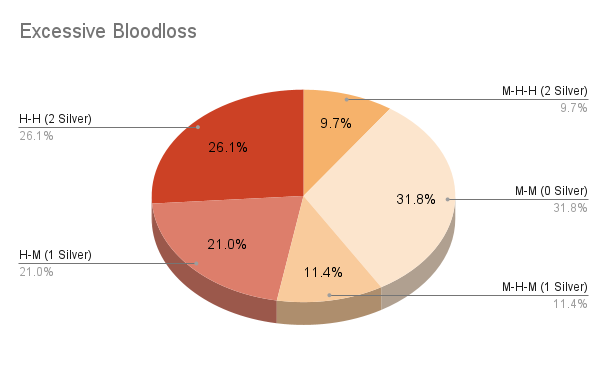
Excessive Bloodloss is the most complicated contract LSS has printed from a math perspective. Unlike other utility contracts like Surgical Extraction which are more impacted by gamestate and decision making for it's extra silver, Excessive Bloodloss is all deck and hit numbers, and it's always a fixed amount. That means we can math it out.
The easiest way to math it out was to determine every possible scenario and determine the probability of getting that scenario given the decklist in question. The scenarios and equations are as follows:
No hit on top, fateseal it to the bottom, miss - (1-(H/T))*(1-(H/(T-1)))
No hit on top, fateseal it to the bottom, hit, miss - (1-(H/T))*(H/(T-1))*(1-((H-1)/(T-2)))
No hit on top, fateseal it to the bottom, hit, hit - (1-(H/T))*(H/(T-1))*((H-1)/(T-2))
Hit on top, leave it on top, hit, miss - (H/T)*(1-((H-1)/(T-1)))
Hit on top, leave it on top, hit, hit - (H/T)*((H-1)/(T-1))
This might be completely indecipherable, so let me explain the results.
Essentially, after doing the math and averaging it out, you get the following results:
47.19% of the time, you'll trigger Huntsman and find a red on top. Once you banish it, 26.15% of the time you'll get a second red beneath it and 21.04% of the time you won't.
51.81% of the time, you'll trigger Huntsman and won't find a red on top. When you bottom it, you have a 21.04% to find a red and a 31.77% chance not to. If you do find a red, you have a 9.67% chance to hit a second red and a 11.37% chance not to.
If you add things together, you have a 35.82% chance to generate two silver, a 32.41% chance to generate one silver, and a 31.77% chance to generate no silver. Once you average it out and math it up, it comes out to an average 1.04 silver generated across an average 1.68 cards banished.
If you are not playing Huntsman, such as in a Silver Age setting with Nuu, you're looking at a 26.15% chance to generate two silver, a 21.04% chance to generate one silver, and a 52.81% chance to generate no silver. Once you average it out and math it up, it comes out to an average 0.73 silver generated across an average 1.47 cards banished.

Hunter or Hunted is one of the most incredibly designed cards in the game - but we won't talk about that in an article devoted to math.
The math for Hunter or Hunted is pretty easy to put together: Simply take a deck, count up the amount of copies of each card, and determine the chance to hit a 1, a 2, a 3, and a 4+.
Adding it all up, Hunter or Hunted has a 4.95% chance to hit a 1 of, a 8.85% chance to hit a 2 of, a 67.00% chance to hit a 3 of, and a 19.20% chance to hit a 4 or more of. Once you math out the expected silver, it comes to an expected 3.00 silver per resolution.
Except that's not the whole story, because unlike anything else we've talked about, Hunter or Hunted is looking for specific cards across the entire deck. All of these numbers were generated based on starting deck scenarios, meaning no cards have been lost from circulation. If you wait till turn 20, most cards are already out of circulation and you'd be hard pressed to generate anything other than a single silver. In other words, Hunter or Hunted starts at 3.00 average silver and then declines from there as the game goes on.
Unfortunately, to get exact math from here, it requires heavy data gathering, requiring a massive collection of Hunter or Hunted plays, with specifically turn played, silver generated, and opposing hero as the important pieces of data to determine silver generation over time during the game. We won't do this, as LSS gets a bit huffy when you start tracking data that deep.
All things considered, using average numbers, you can attribute a value proposition to the contracts we present. Graven equipment says 2 silver = 2 block at minimum (more on that in the next part), so it's quite literally a 1:1 equation. Plunder the Poor is a 0 for 4.80, Excessive Bloodloss is a 1 for 6.04, Hunter or Hunted starts as a two card 7.00. This is why we run the numbers.
The banish hit% sheet doesn't stop at contracts, though, as I was also curious on the numbers for stealth attacks.

Stealth cards have a much higher volatility than contract cards. Without the balancing factor of Huntsman's fateseal ability, you can't rely on stealth attacks hitting at all.
Art of Desire: Body has the largest raw hit% at 47.19%, with everything else dropping from there.
Unless you're looking at Persuasive Prognosis, that is. Persuasive Prognosis looks for action cards, reaching an 84.71% chance to hit. Persuasive Prognosis is more likely to hit than Plunder the Poor, even when Plunder the Poor has contract to filter. Fun fact, if you were able to fateseal with Persuasive, you'd be looking at an unreasonable 96.33% hit rate.
Effectively, because of the value being guaranteed lifegain, you can math out Bonds of Attraction as a 0 for 1.99 blue and Persuasive Prognosis as a 0 for 1.85 blue. You could theoretically consider Art of Desire: Mind for pitch stacking to where it will almost always hit a blue and turn into a 0 for 4 blue (if you consider drawing a card at 2 value), but that's a setup kind of card that won't work super well earlier in the game.
Long story short, stealths are only really valuable to the hero when there are other synergies and usecases involved. For example, Just a Nick, Looking for a Scrap, utility abilities like Persuasive Prognosis's hand banish, and being a blue.
Part 2: Silver Math
We know how often a silver is being generated, but how much is the silver that's being generated actually worth?
Every single buyback item in the game tells a different story.
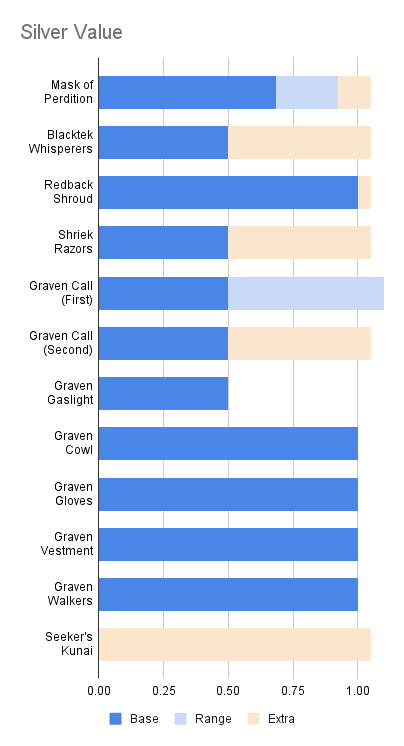
In short, buying back equipment makes silver worth the following value each:
Mask of Perdition - 1 Silver = 0.68-0.92+
Blacktek Whisperers - 1 Silver = 0.50+
Redback Shroud - 1 Silver = 1.00+
Shriek Razors - 1 Silver = 0.50+
Graven Call (1st buyback) - 1 Silver = 0.50-∞
Graven Call (2nd+ buyback) - 1 Silver = 0.50+
Graven Gaslight - 1 Silver = 0.50
Graven Cowl / Gloves / Vestment / Walkers - 1 Silver = 1.00
Seeker's Kunai - 1 Silver = 0.00+
Let's break that down a bit.
The value of a single silver is directly proportional to the value of the object you recur. Each object carries with it a different value, and that value is often a bit flexible in it's rate.
Some objects are easy to math out. Take for example, the Graven gear from PEN. Cowl, Gloves, Vestment, and Walkers are all essentially textless 2 block blade break equipment. They cost two silver to buy back, meaning each silver you pay into the equipment is worth 1 point of block, or 1 value.
Graven Gaslight, also from PEN, tells a similar story. It's effectively textless spellvoid 1. Two silver becomes 1 arcane prevention, meaning each silver you pay into the equipment is worth half a point of prevention, or 0.5 value. There is something to be said that arcane damage is harder to prevent than physical damage, so having an extra prevention is more useful than having an extra block, but as this is an article that almost exclusively focuses on raw math and numbers, we will mostly ignore those scenarios.
Beyond that, the numbers start to get a little variable.
The first buyback set, which includes Mask of Perdition, Blacktek Whisperers, Redback Shroud, and Shriek Razors all roughly carry the same type of abilities. They all carry 1 block battleworn and an activated attack reaction ability. This means that the bare minimum value out of each equipment is 1 block, which comes about to 0.5 value per silver paid into it.
The activated attack reaction is where value starts becoming a little interesting.
Mask of Perdition has the activated ability to destroy itself and give an on hit to your current attack to banish the top card of the opponents deck. The inherent value of this ability is pretty low, as a single card being banished from the deck is relatively limited in it's impact. The real power of the ability comes from the extra generation of silver and lifegain.
There is no fateseal involved in a Mask of Perdition banish, meaning the chance to hit a success is the raw, unchanged hit%. Surgical Extraction is 36.69%, Plunder the Poor is 61.98%, and Persuasive Prognosis is 84.71%. Technically, Nix the Nimble is 11.24%, but no deck is running that card, so we don't really care.
In fact, the lowest % chance that a deck is typically running is found in Surgical Extraction and Art of Desire: Mind at 36.69%. If you're on Slay the Scholars or Rob the Rich, it's as low as 32.54%, but we'll use 36.69% as our baseline here.
Thanks to Silver being worth 1 value when used on Graven equipment, we can treat the silver as 1 value in this equation. Technically, we could treat the silver as whatever value we find from this equation, but that would cause a negative feedback loop that means the total value of silver spent on Perdition collapses to around the base of 0.5. We won't do that, because it's going to give us faulty numbers and faulty results that don't tell the whole picture.
We can also treat 1 lifegain as being worth 1 value for hopefully obvious reasons. This means that 1 hit is worth an expected 1 value.
So, all that considered, 1 activation of Mask of Perdition will end up being worth anywhere from 0.36 to 0.84. Add that with the 1 block, and it means two silver comes out to 1.36-1.84 value combined, or 0.68-0.92 each.

You may note in the graph above the presence of the "+" next to it. Quite simply, there is "hidden" value in the card. Mask of Perdition is an activated attack reaction ability, which works favorably with cards like Double Trouble.
In general, FaB seems to treat these attack reaction threshold cards at about 1 value per reaction (Bonds of Agony is three for +3, Double Trouble is two for +2, Sneak Attack is one for +1). If you save the reaction ability for these cards, you can essentially add an extra point of value onto it's reaction. Because of this added variable value in certain situations, all objects like Mask of Perdition have a "+" next to their value to say it can carry extra, added benefit.
Blacktek Whisperers is an easier equation, as it doesn't involve extra banishes or silver or anything like that. It's activated ability is simply on hit go again.
Using actual Flesh and Blood cards, you can see that on hit go again is considered to be worth 0 value. There is theoretical implied value, but raw numbers are worth 0. Take, for example, the two Ninja cards, Torrent of Tempo and Soulbead Strike. A general "rate" for a 1 cost attack is 5 damage, and a 0 cost attack is 4 damage. These two cards carry that same general rate with the addition of "When this hits, go again."
However, given you can add this on hit onto any Assassin attack, the implied theoretical value of this card could be orders of magnitude higher than 0. Unfortunately, though, all of that is gamestate and situation specific and so can't have an exact number added on. Hence, Blacktek Whisperers is 0.5+ value per silver.
Redback Shroud is the easiest card to look at of these four. It's activated ability reduces the cost of an attack reaction by 1. That's one resource, 1 value. If two silver get you 1 value in the resource and 1 value in the block, then each silver is worth 1 independent value.
Add in the reaction threshold and you get 1.0+ value per silver, which isn't bad at all. The only problem with the card is the incredibly limited usecases of the resource that's generated, but that's a discussion for an article that isn't directly focused on math.
Shriek Razors is a problem. I actually don't know exactly how to rate this card because it's bad.
From a math perspective, the activated ability costs 2 resources and reduces a card by 1 block. In other words, the value of the ability on paper is technically -1. That means that activating the equipment leads to -1 value, which when combined with the 1 block value, gets you to a net 0 object.
Unfortunately though, you don't technically have to activate it, meaning the value of buying the object back has a minimum of 0.5, assuming you don't ever use it's ability.
Granted, there is theoretical implied value from the ability always being present and threatened, as well as the threshold value from it being an attack reaction. Even with those though, there's still a massive gap to cross when it's minimum is technically net 0 value.
As a suitable replacement for Shriek Razors, LSS printed Seeker's Kunai, the most interesting of the buyback objects. That said, Seeker's Kunai presents the worst silver rates. It's ability is a 1 for +1 attack reaction, which means it's technically 0 net value. It does carry the implied value from always being threatened, as well as the threshold value from being an attack reaction, and it is substantially easier to activate than Shriek Razors, giving +1 to any attack rather than -1 to a defending attack. On paper though, it is still net 0.
Additionally, Seeker's has no extra benefits like the block from the Graven gear or the original buyback gear, meaning it doesn't get the base value found on them.
All together, Seeker's Kunai converts at 0+ value per silver. The extra value can be quite significant, but there's no mathematical baseline for it, meaning it's not strongly represented here.

Last but not least, Graven Call is the most interesting buyback object in the game, as the numbers are technically different in the first buyback compared to every other object.
For analyzing Graven Call, we will be treating it as though it's also paired with Flick Knives. The reason being that the numbers on buying the equipment back don't really get impacted that much by the exact source that's throwing it. As long as damage is dealt and the dagger is destroyed, we don't care that much about it.
The damage is the important bit, as daggers on board technically represent 1 true damage from a variety of sources. This means that buying Graven Call back gets you an extra source of that true damage later on. This effectively means that every single buy of the dagger gets 1 damage, meaning the baseline for Graven Call is 0.5 value per silver.
As with every other on board attack reaction though, Flick Knives itself does come with the extra threshold value for cards like Double Trouble, increasing the potential value of the silver spent on the weapon.
The first buy of Graven Call is important though, as it's what allows you to put a +1 counter on it. That +1 counter is perhaps the most incredible +1 counter in the game.
Imagine this, you are playing a game that lasts 20 total turns (More on that in the next section). For 15 of those turns, you managed to send a dagger for 1 damage before your contract attack. In total, you presented 15 damage across those turns. Now, after 5 swings of the dagger, you managed to throw and buyback Graven Call. For the remaining 10 swings, you're now swinging for 2 instead, allowing you to present 25 damage across the total 15 swings. This means that effectively, the two silver you spent on this ended up generating an extra +10 damage, making each silver settle on 5.5 value (Extra 0.5 value from the flick).
5.5 value per silver. Every other object is topping out at 1.0+, and this scenario has it at 5.5. Granted, there are some conditions. You have to swing Graven Call, and the game has to last a long time. You could theoretically buy it back and then never swing it again. Or you could buy it back and end up still having 20 turns left to swing it 20 more times. The volatility is huge, and it won't feel incredible when it's spread out over so many turns.
In short though, on paper, it's an absolutely incredible amount of value generated in your silver. Imagine presenting T1 Plunder the Poor, a 0 for 4 that on hit has an 80% chance to generate you 5.5+ additional value. That's almost a one card 10!
As a whole, Silver is generally worth about 1 point of value, though there are definitely cases where it is significantly less and definitely cases where it is significantly more.
Part 3: Fatigue Math
All this silver value, but there's one thing this article has so far largely ignored: What is the inherent value of banishing a single card from the defending hero's deck?
In short, it's low. When I asked earlier in the purple discord what people value a single banish as, the general consensus I got was that most people only really care about the banish if it hits a good card. If it's an average or bad card, it's basically a non-factor.
I wanted to try and figure out what the actual value of a banish is, to try and see the difference between public consensus and actual math. However, this is a really difficult ask. Banishing cards is so nebulous in impact that you can't easily quantify what exactly you're getting out of a random individual banish.
But, I had to try, I had to give it a go.
Be advised, this section is the most "psuedo science" of any math in this article. The other sections are, for all intents and purposes, actual data driven math with actual tangible numbers and meanings. This is not. This is more an attempt to put numbers in a space where numbers arguably shouldn't exist. You can draw your own conclusions from the data, and they could be entirely different than what I came up with.
Long story short, the answer I came up with is that a single banish is anywhere from 0.32 to 0.56 value.
Short story long, here's how I came up with it.
If damage wins the game by hitting a certain damage threshold (40 life), fatigue wins the game by hitting a certain turn threshold (however many turns it takes your opponent to run out of cards).
If I can figure out the percentage of a game that a single banish hits, and I can figure out the percentage of a game that a single damage deals, then we can compare the two to find a rough raw value amount of the banish.
Step 1: How long does a game last?

Let's take three scenarios:
Scenario 1: Your opponent loses an average of two cards from circulation every single turn. Example - Guardian, who can just block two pitch two hammer every turn.
Scenario 2: Your opponent loses an average of three cards from circulation every single turn. Example - Katsu, who tries to pitch a single blue 0 cost to Kodachi every turn to fuel most of the game.
Scenario 3: Your opponent loses an average of three and a half cards from circulation every single turn. Example - Boltyn, who is often playing out a full hand and rarely pitching cards, but might pitch a card every other turn or so for his 1 cost cards.
In scenario 1, by losing two cards every turn, with a 60 card deck, they will run out of cards after 30 turns.
In scenario 2, by losing three cards every turn, with a 60 card deck, they will run out of cards after 20 turns.
In scenario 3, by losing three and a half cards every turn, with a 60 card deck, they will run out of cards after a little more than 17 turns.
Step 2: How much does a banish change the length of the game?
Generally, a single turn consists of 4 cards. Thus, if you banish a card from deck, you are reducing the overall game length by a quarter of a turn. After four banishes, you have reduced the game length by 1 turn.
In scenario 1, with 30 turns, a single banish is worth 0.8% of the game (0.25/30).
In scenario 2, with 20 turns, a single banish is worth 1.2% of the game (0.25/20).
In scenario 3, with 17 turns, a single banish is worth 1.4% of the game (0.25/17).
Step 3: How does this compare to damage?
If you've got a single damage, you are dealing 2.5% of the total damage threshold required to end the game (1/40).
1 damage is roughly 1 value, so 1 value is roughly 2.5% of the total game completion.
This means that in scenario 1, at 0.8%, that is roughly 32% of the value of a damage, meaning it is valued at roughly 0.32.
In scenario 2, at 1.2%, that is roughly 48% of the value of a damage, meaning it is valued at roughly 0.48.
In scenario 3, at 1.4%, that is roughly 56% of the value of a damage, meaning it is valued at roughly 0.56.
So, this pseudoscience number slop leads us to a relatively useless answer that a single banish from deck is worth roughly 0.32 to 0.56.
The neat part of this whole thing, though, is that these numbers do kind of confirm the general consensus. At 0.32, it takes 3 banishes to be worth roughly the same as a single point of damage, and at 0.56, it takes 2 banishes. In small numbers, your banishes aren't worth a whole ton, not unless you manage to banish a power card like Bloodrush Bellows from Brute.
Part 4: Conclusion
Math is neat, and knowing the numbers can be a good thing. Knowing the likelihood of a single silver being generated from a Plunder the Poor isn't going to magically make you better at the game, but it can improve your decision making process.
The key takeaways from this article really can be summarized as the following:
Banishing a sinlge card isn't worth much unless you're hitting a power card or generating a silver. The value of a silver is large enough that you really should be prioritizing silver generation with your top deck manipulation.
As far as silver generation is concerned, your best contract attacks are Excessive Bloodloss, Plunder the Poor, Leave No Witnesses, and Annihilate the Armed.
Those four contracts carry with them the following value based on the math above:
Excessive Bloodloss -> 1 for 5 (Damage) + 1.04 (Silver) + 0.32 (Worst case banish value) = 1 for 6.36
Plunder the Poor -> 0 for 4 (Damage) + 0.80 (Silver) + 0.32 (Worst case banish value) = 0 for 5.12
Leave No Witnesses -> 0 for 4 (Damage) + 0.68 (Silver) + 0.32 (Worst case banish value) = 0 for 5.00
Annihilate the Armed -> 1 for 5 (Damage) + 0.60 (Silver) + 0.32 (Worst case banish value) = 1 for 5.92
As far as buyback objects are concerned, buying back Graven Gear is really good at a guaranteed 1 for 1 value ratio, buying back your first Graven Call is theoretically insane at upwards of 1 for 10 value ratio, and buying back reaction gear like Mask of Perdition is a good call thanks to the 1 block + theoretical implied value from the reaction.
If you have about 10 guaranteed banishes with Hunter or Hunted and Coercive Tendencies, that starts you with 10 silver + however many silver you generate from regular contracts, meaning you have 5 "free" buybacks. How you spend them is up to you, but 10 life from Graven Gear or 5 life and 5 banishes from Perdition are good ways to look at things.
Now go forth and fatigue people!
If you like what you read here, please consider supporting me on Metafy. This website costs money to host, and I put a lot of time and effort into the words you're reading. Even just a single dollar a month goes a long way.


