
The Shape of the Tavern

After posting my last article, I've been thinking a lot about what exactly I want my custom cube to look like.
To recap, in my last article (A Group of Assassins Walks Into a Bar), I created 10 preliminary Assassin heroes to explore within the context of a custom cube. Each Assassin used a different talent to explore both talent design spaces and class design spaces.
After sitting on all 10 ideas, I have settled on two thoughts:
Firstly, the cube I will create is a Draconic / Light / Mystic - Assassin / Class cube utilizing K'aakai, Harker, Wan, and three other talented heroes of a different class. Obviously, those three heroes' exact wording is subject to change, but the base ideas presented in their cards are still there.
Secondly, while this cube will not feature Lock and Rat, those two heroes are still designs I am eager to explore and play with. In other words, I'm not shelving them permanently, just putting them on the back burner for a future cube.
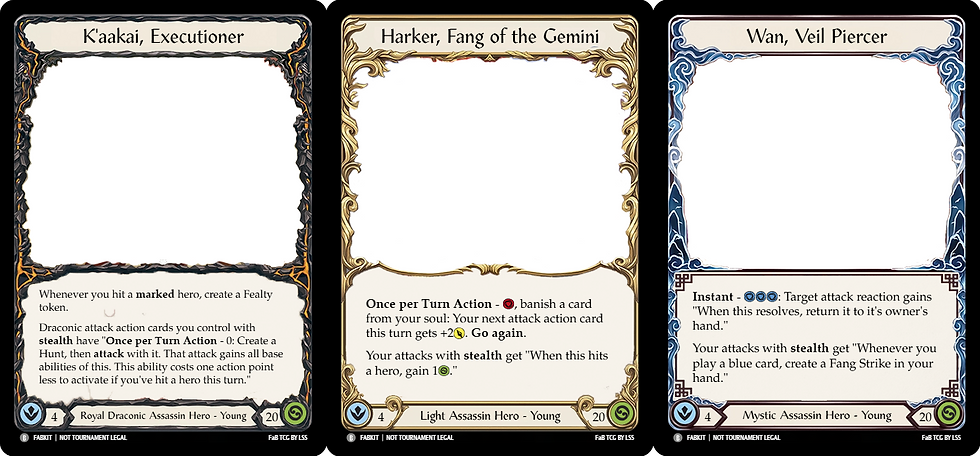
The next step towards creating a fully realized cube is to start assembling some preliminary card pools and draft archetypes, as well as outlining the other side of the cube.
Assassin cards are split into the three talents, with each talent pushing their cards into very different directions. To dive into what the Class itself is doing, we must first establish a baseline of what the talents are doing.
Draconic was the hardest to think of ideas for, as the base fundamental idea is "Attack multiple times." Go again is a relatively non-complicated keyword that leaves the mechanical intrigue a little wanting. However, K'aakai themselves bring about an immediately interesting design space to play in: Attacks that don't require action points.
Attacking without an action point is a very dangerous space to play in, so I don't want to throw the ability around like it's nothing. My first thought for this effect is to tie it to Mark, a keyword we're already taking advantage of in the cube. A simple card design here could be a 0 for 4 with 3 block and the text "While an opponent is marked, this costs one less action point to play."
The more we fill the card pool with these effects that key off of marking, the more marking itself becomes impactful. Immediately, I am drawn to the on-hit mark effect, which creates a complex decision point for the opponent. Something as simple as a 0 for 4 with "When this hits a hero, mark them" raises a ton of questions as to what a follow-up might look like.
As for what the Assassin card pool might look like when combined with Draconic, I think the best way to interact with the card pool would be to use effects that key off of attacking multiple times.
With all things considered, here are a few cards you may want to draft in the K'aakai card pool:

Light, as I said in the previous article, is a talent that needs a complete and utter overhaul. I, for one, am very interested in creating that overhaul.
Assassin and Light are an interesting combination, but it doesn't actually create a meaningful and intriguing playground for this overhaul. Thankfully, I'm writing this first section of the article, focused on the design space of the three talents, at the same time in which I'm writing the second section, focused on the other class to put in this cube. So I do have the other classes to work off of here.
Do y'all remember Glisten? If you don't, here's the card: 2 cost Light Instant that puts four +1 counters on weapons you control and removes them all at the end of the turn. It's a forgettable card, but it does raise a flag for something interesting I can play around with: +1 counters.
Do y'all remember Ironfist Revelation? You should; it was released very recently. If you don't, though, it's a Guardian arms equipment with temper 2 and "When this defends, you may turn a face-down card with crush in your arsenal face-up. If you do, put a +1 counter on it." This card is already putting +1 counters on attack action cards, meaning this design space is something we can easily play around in.
You may already see exactly where I'm going with this, but on the off chance you don't, let me spell it out. I think Light can easily play around with adding +1 counters to attack action cards on the combat chain and can key off of those counters.
We need two pieces for this effect. Firstly, we need cards that put +1 counters on attacks, and secondly, we need cards that key off of +1 counters on your attacks.
The former is easy enough. Even just something as simple as a Nimblism-type card can work well here. "The next attack action card you play this turn gets 'When this attacks, put three +1 counters on it.'" Perfect.
The latter is also easy enough. We can also utilize this space to promote the other idea we developed with Harker: life gain. "If this has a +1 counter on it, it has 'When this hits a hero, gain 1 life.'"
The Assassin card pool, combined with Light, will probably use these +1 counter buffs to key themselves. Personally, I'm very partial to the 0-cost Guardian attack methods. Just key off of having power greater than its base.
With all things considered, here are a few cards you may want to draft in the Harker card pool: (Big, huge, amazing shoutout to Thencros and the team behind https://fabkit.io/#/. The Light frame was put together and released about two days before the release of this article. I had to request it specifically for this article, and they put it together for me. Thanks again, Thencros!)

Mystic is an incredibly well-thought-out talent in MST. It may have had some power level concerns, but the things it did were very in-depth and wonderfully creative. The only area where I personally feel it lacks is in its tokens.
This is not to say that Mystic doesn't create tokens. Assassin has Fang Strike and Slither, Ninja has Crouching Tiger, and Illusionist has Spectral Shield. No, the problem I face here is that while the talented class cards create these tokens, the talent itself doesn't have its own token to create.
Obviously, this was for complexity budget reasons within the original set, but I have decided to rectify it here. Additionally, this need for a token solves another problem that I face in this cube: double-sided cards. While it's definitely not hard to print double-sided cards, it adds a level of complication to the physical creation of this cube that I don't want to figure out. So why not make Chi a token created by Mystic effects?
Two other spaces I want to play around in are attack reactions (As seen in Wide Blue Yonder) and "If a Chi was pitched to play this" (As seen in Orihon of Mystic Tenets).
Given the space has already been tread on for both areas, and I'm not doing anything too unique within either, I don't think I need to go as in depth on the complexities that can be created with these two design spaces, as I did with Draconic and Light. They're relatively simple concepts with broad executions.
How the Assassin card pool interacts with it is also relatively easy to find. Double Trouble is a card that exists, and Wan is already creating extra attack reactions with every instant speed blue.
With all things considered, here are a few cards you may want to draft in the Wan card pool:

To recap, the primary mechanical lines we've created for the three talents are as follows:
Draconic - Mark to attack without action points. Additionally, rupture and red/Draconic matters cards will be featured throughout the cube.
Light - Give attacks +1 counters for extra benefits. Additionally, soul, yellow matters, and life gain will be featured throughout the cube.
Mystic - Create Chi to fuel attack reactions. Additionally, blue matters and second-cycle recursion will be featured throughout the cube.
With some of these fundamental designs created, we can start exploring the design spaces for the other side of the cube.
What class might be paired with Assassin?
To narrow things down, a better question might actually be, what classes should not be featured in this cube?
First, there are a few classes I struggle with on a fundamental basis.
I do not enjoy allies or ally-focused design spaces, so both Illusionist and Necromancer are being cut from consideration immediately. The same can be said for arcane damage, leading to Wizard and Runeblade being cut as well.
Next, a couple of classes get the axe due to non-functionality within the cube's design space.
Guardian is incredibly interesting, and there are ways to make the class work within the framework provided, but Draconic does not play nicely with Guardian concepts. Going wide and staying small is possible, as seen with the Cut cards in SUP, but I don't want to warp class design around making it work.
Along a similar vein, Ranger features a ton of interesting thoughts, especially within Light and Draconic. That said, reactions and instant speed gameplay don't really make sense within the framework for a Mystic Ranger. I think I would prefer to leave it on the chopping block.
Along the same lines as Guardian, Brute features a ton of inherent problems with pretty much everything I've created. Brute would need to function with reaction speed gameplay, long chain links, and +1 counter buffs. The class can work in all of the above, but requires a ton of extra legwork I don't really care to put in.
All things considered, that leaves three classes available: Ninja, Warrior, and Mechanologist.
They all offer a plethora of benefits, but I'm unsure which to explore further. Thankfully, I have an exercise that can solve this very problem. Like in the last article, it's time to create 9 different heroes within the frameworks we've created for the talents above. 3 Ninjas, 3 Warriors, and 3 Mechanologists.
Ninja, as a class, is fundamentally based on attack sequencing. Katsu cares about combo sequencing named cards, Benji and Ira care about sequencing attacks to maximize the value of the +1 hero ability, Fai cares about sequencing attacks for Phoenix Flame, and Cindra cares about sequencing dagger attacks and dagger-throwing attacks.
As far as this cube is concerned, that sequencing will mostly be coming in the form of tracking the power of previous attacks in the combat chain. Ninja will gain bonuses for descending powers (5 -> 3 -> 0), ascending powers (1 -> 2 -> 5), or stagnant powers (4 -> 4 -> 4). Different cards will work in different power variances, but this kind of sequencing is where I personally draw the most excitement.
Mystic Ninja is a class talent combination that already has a well-defined archetype in the form of Crouching Tigers. I like the idea of playing around with Crouching Tigers, but I want to play around a little differently with it than Zen might.

Benji is my all-time favorite Ninja hero, and I really wanted to use this space to give Benji a new home.
Most of that space comes from the bottom ability. Benji historically is known for playing cards with 2 or less power, and Benji in this environment is continuing that trend.
Within the context of Ninja, Benji is typically trying to end their turn with these low-power attacks, using the 2 power to close into a 0-power Crouching Tiger.
Mystic Ninja works their attack sequencing lines into the descending approach, starting high and ending low.
The top ability for Benji is 90% flavor, though it does create some interesting design space. Within Ninja, there will be featured a few cards that jump onto the top of your deck, like how Salvage Shot in Ranger goes to the bottom. With these attacks, you can use Benji's ability to freely draw them back into your hand to continue extending your turn.
Outside of that, it will obviously be used by devoted pitchstackers who are itching for some way to express their perfect knowledge of their deck.

Wyll is where I came up with the entire identity for Light around +1 counters.
Wyll has relatively low value, with no passive abilities, unlike other heroes in the cube. Instead, though, it is arguable that Wyll has one of the most powerful active abilities in the cube.
To boil it down in the most concise way possible, the ability works as follows: Once you activate it, pick up any number of +1 counters on attacks you control. Then, put each counter back down on attacks you control, making sure to only put down a single counter on the active attack.
So, why does that matter?
In the most basic use case, you can double up on +1 counters and +1 counter-related abilities, moving the counters across chain links. More excitingly, though, you can manipulate the power of existing attacks to fulfill the conditions of Ninja attack sequencing.
Descending power, ascending power, stagnant power, whatever is needed for your hand is completely possible to craft with a single activation of Wyll and just a few +1 counter generators.

Eun is an interesting character in the lore. She's essentially just Fai's warmongering girlfriend who got eaten by a dragon to narratively radicalize the hero and incite him to take the actions that would lead to the events of UPR, DYN, OUT, and arguably every other major story since, thanks to Shiyana's involvement.
I think it's a shame there hasn't really been any movement on that specific portion of the story since the release of those sets, with Fai being essentially benched for the time being. As such, I'm taking the lore into my own hands for Eun, giving her a backstory rooted in nobility to help justify a lot of the actions taken during her story.
That said, you're not here for lore. Let's talk shop.
One thing I didn't want to rely on here is the previous format of Draconic Ninja, focused on an activated ability with reduced cost for each Draconic card. I still wanted an activated ability, though, and I wanted it to be an action point sink to work within the framework of Draconic in this cube.
The actual verbiage of this sink is powerful. If you have extra action points and enough Draconic chain links, you get the chance to get a card for free, with added damage on top. And you aren't even limited to doing this once per turn.
If the stars align, this hero ability can easily represent 10 extra value in a turn. That said, the stars really do have to align. Extra action points and long Draconic chain links are one thing, but sometimes you just don't get to see a playable card on top.
As the mother of all high-roll heroes, I'm excited to see the insane turns players can put together. Just double-check to make sure Dromai didn't sneak into the card pool somewhere to eat you.
Warriors are a class that kind of has an identity crisis. LSS has stated that the class is supposed to have above-rate weapons and built-in quest lines so that you can achieve even more strength, but none of the existing cards, outside of maybe Fang, really help to hammer that design intention in.
When thinking about how I'd work Warrior into a cube setting, I would lean into the quest lines specifically. Fang was masterfully executed, to me, with his quest for three Fealties. It didn't work that well from a power standpoint, but I love the idea presented for these quests.
Thus, each Warrior hero will come built in with a quest to achieve over the course of the game.

Monte introduces our first quest: Put a red card into your pitch zone. Unfortunately, this is easier said than done.
Monte's daggers are 0 cost, and most Draconic cards are low-cost beaters. To turn on Monte, you will need to really prioritize 1+ cost cards in your draft.
Beyond that, though, getting a red card into your pitch zone requires you to lose a ton of value that you would normally find with blues.
Notably, Monte's ability does create a pretty significant implication. Namely, Monte will live and die by effects in the cube which allow you to activate weapon abilities an additional time.
This implication goes a little further, though, as you have to consider where those extra attack cards come from. In Draconic, they'll have low impact alongside Assassin. In Warrior, they create a need for use cases within the other two Warriors. As I don't want to design a useless mechanic for Assassin, they almost definitely have to come from the Warriors.
This is why I started with Monte, because I needed to establish the extra attack archetype within Warrior.

Danu's quest is built on the framework established in Wyll, using the +1 counters featured in the talent.
Danu's Axe is a 2-cost 3-power attack, meaning that to complete the quest, the following three things need to happen: Put a +1 counter on the weapon attack. Get the attack to 7 power. Hit with the attack. Once all three conditions are met, you get to keep one of the counters around permanently.
That last part is important, though. Danu is built on the understanding that weapon attacks are proxies and not the weapons themselves. It is incredibly important that all drafters and players understand that if you put a +1 counter on the Axe attack, it is not being put on the Axe itself.
Notably, the counters have no built-in end clause. This is by design, forcing you to play a low-rate game plan until you can start getting the ball rolling into some big weapon swings for a low cost.
The top ability on Danu is a very important tool as well, allowing you to open your turn with an Axe attack, leaving your opponent guessing as to whether you'll follow it up with more attacks or pump the Axe over their blocks.
Additionally, you can use the go again from Danu in conjunction with the extra attack cards to swing your weapon a few times in the same turn.

Chakra is one of the most mechanically complex heroes in this cube. You can't even see all that they're doing on their hero card alone.
Chakra comes with a sword and shield pairing. Her shield allows you to convert chi into defensive value, becoming even stronger the more cards you commit to block. If you commit enough, the shield will ascend Chakra itself. Her sword is a below-rate weapon that swings in for way more value while ascended and can even ascend Chakra itself with enough value.
In other words, Chakra is a stance swap hero, where you use Chi to either swap into defense form by ascending the shield or offense form by ascending the sword. Regardless of which stance you swap into, if you complete the quest, you get a whole turn of "free" blues.
Is Chakra too complicated for fun and engaging limited gameplay? Maybe. Do I care? No. The power fantasy of playing a stance swap Warrior is too cool to pass up.
Mechanologist may have been a surprise for a class to border Assassin in this cube, but I personally feel it can create some of the more interesting play lines of the three choices.
Mech has a significant hurdle to move past: Boost. Boost is a parasitic mechanic baked into the core class identity that requires you to play a higher volume of Mechanologist cards. In order to adapt that identity into a cube environment designed to leave you with a 50/50 split of class and talent cards, I've designed a new keyword along the same lines: Overload. Overload is a keyword with the reminder text of "As an additional cost to play this, you may banish the top card of your deck." Overload cards then come with the text "If this was overloaded, <effect>."
With that keyword out of the way, let's start talking about some Mechanologist heroes.

Celeste introduces Insight tokens. These are colorless 0-cost Mechanologist instants with two abilities.
The first ability is a static effect that says, "Whenever an effect you control banishes this from your deck, draw a card." This effectively turns Insight into a payoff for overload. Should you find it on top, overload it away and draw more gas to extend your hand.
The second ability is an on-play ability, though I'm not 100% locked in on what that ability is. Currently, my thought is that it allows you to look at the top card of your deck, which gives you information for additional overloads. That said, the impact of the effect feels very minor and may need to undergo some adjustments.
Celeste offers a unique draft style. You want chi to create insights, but you don't want too many chi and insights, as it might leave your deck with zero ability to block or play cards. You can very quickly create so many tokens in your deck that you end up drawing a hand that doesn't do anything at all.
Assuming you manage to properly balance your Chi and insight, though, you can take advantage of your overload to extend your hands and the second ability to drop powerful items on the field at reaction speed.
Before we move on completely from Celeste, I did just want to briefly touch on the flavor of this hero, as I'm quite proud of the concept. Celeste is an astronomer who moved from Metrix to Misteria so that she could escape the light pollution of the big city. Within her observatory on the peaks of Misteria, she gazes into the cosmos and unravels the great mysteries of the universe.

Leonardo is a math equation. I'm not even sure I have the math correct here.
Essentially, play out an attack, buff it until you get to double its power, close the chain, use the action point from the Cog to activate the hero ability, and swing with a card and your weapon.
Immediately, I can twiddle some knobs as necessary if the math equation is incorrect. Restrict the second ability to yellow attacks, reduce the cost of the first ability, limit the turn-wide buff to just a single attack, change the +1 passive to a +1 counter, and so on and so forth.
The hero text is incredibly variable at this stage in the design process, way more than any other hero we've seen. Which kind of makes sense for a Mechanologist hero based on Leonardo Da Vinci.
Anyways, I'm running out of things to say on the hero because it's mostly self-explanatory, so we'll move on.

Draconic Mech is a very fun class talent combination. Draconic attacks without spending action points. Mech generates action points. Thus, Draconic Mech gets to manipulate action points as needed.
Thorin's hero ability was built from that idea, as a simple action point sink that you can funnel excess action points into.
Forge is where a lot of the intrigue comes from, allowing you to untap your tapped items for extra value while keeping them around an extra turn.
Thorin has two distinct archetypes that they'll be playing in.
In one deck, Thorin will be using Draconic cards and Mechanologist cards to extend their hands, taking advantage of the hero ability to double up on item activations and weapon attacks to extend a little bit further.
In the other deck, Thorin primarily utilizes the hero ability to keep their items sitting around while they build up a devastating board state and endgame.
The primary goal with the card pools here will be to support both decks and allow both to be drafted and played, depending on the drafter and situation.
There are a lot of interesting playlines and cubes you can construct with any of these three classes.
Ninja offers some of the most interesting sequencing lines. Warrior offers some of the most interesting hero cards. Mechanologist offers some of the most interesting deck cards.
At the end of the day, I'm not really sure which of these cubes I want to go with. Whichever one it is, my article in the second half of the month should hopefully be essentially a cube directory in preparation for a first draft. It'll be tough to make everything. At 360 total cards, that means I have to make roughly 18 per day. That said, there's no better way to begin than by beginning. So let's begin.
As I put pen to paper and create some cards, you'll be able to see them here on the website. Navigate to the top bar and go to "The Tavern", a new page I've created specifically to house my designs.
Pop in every once in a while just to see where progress is at. And if it looks particularly slow, nudge me on Discord or on Bluesky.
If you would like to join the conversation, I'll be talking about this a lot in the FabCube Discord, which you can find here: https://discord.gg/87mdzaqvzj
